
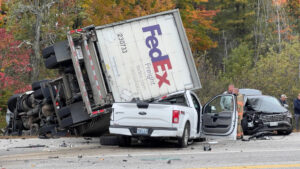
If you were hit and injured by a FedEx truck in Missouri, what you do now is: get medical care immediately, stop direct contact with FedEx’s insurer, preserve time-sensitive trucking evidence (video, driver logs/ELD data, black box data), and call Sansone & Lauber at 314-863-0500 so we can protect your claim and pursue maximum compensation.
Call RIGHT NOW and speak with a lawyer for FREE at 314-863-0500. Our attorneys are standing by to take your call. Don’t Wait! Waiting only hurts your case! The sooner you call us, the sooner we can help you!
What To Do After You Get Hit By A FedEx Truck In Missouri
After a FedEx truck hits you in Missouri, you should: (1) get medical care and follow up, (2) report the crash and document your injuries and the FedEx vehicle identifiers, (3) do not give a recorded statement to FedEx’s insurance, (4) demand immediate preservation of evidence like onboard video, electronic logs, and maintenance/dispatch records, and (5) speak with a Missouri truck accident lawyer fast—because motor carriers must retain records of duty status and supporting documents for six months, and video/data can be overwritten sooner without a preservation demand.
Why a “FedEx truck accident” is different from a normal crash
A crash involving a FedEx-branded vehicle is usually a commercial claim, meaning:
-
The defense is more aggressive (higher exposure = harder fight)
-
Evidence is more technical (logs, ELD data, dispatch, maintenance records, onboard cameras)
-
Liability is often more complex (the driver may work for a FedEx entity, a contractor, or a separate company)
-
Insurance coverage can involve multiple layers, policies, and corporate entities
The key point is simple: FedEx and its insurers will move fast to control the story. You need to move faster to protect yours.
Call RIGHT NOW and speak with a lawyer for FREE at 314-863-0500. Our attorneys are standing by to take your call. Don’t Wait! Waiting only hurts your case! The sooner you call us, the sooner we can help you!
Step-by-step: What to do after being hit by a FedEx truck in Missouri
Step 1: Protect your health first (and document the injury properly)
Get medical care immediately
If you were hit by a delivery truck or tractor-trailer, you may have injuries that do not fully show up at the scene:
-
Concussion/TBI symptoms (headache, dizziness, fog, nausea)
-
Neck/back injuries (disc injury, nerve irritation)
-
Internal injuries
-
Soft-tissue injuries that intensify over 24–72 hours
Tell providers it was a FedEx commercial vehicle crash
Your medical records become your proof. Make sure the intake notes reflect the mechanism of injury (hit by a commercial/FedEx truck) and your symptoms. Don’t downplay pain. Don’t “tough it out.” In commercial claims, insurers attack gaps and inconsistencies.
Follow treatment plans and avoid gaps in care
A treatment gap is a defense gift. It becomes:
-
“They weren’t really hurt.”
-
“They recovered quickly.”
-
“This is from something else.”
If cost is a problem, talk to a lawyer first. There are ways to keep medical documentation clean while managing care strategy.
Step 2: Do NOT hand FedEx’s insurer a “discount” on your claim
Don’t give a recorded statement
FedEx’s insurer (or a third-party claims administrator) may call quickly. They will sound helpful. Their questions are designed to lock you into statements that can reduce value or increase blame.
A recorded statement is one of the fastest ways injured people harm their own case.
Don’t sign broad medical authorizations
Insurers often ask for blanket authorizations so they can comb through unrelated medical history. That is rarely in your best interest.
Don’t accept a quick settlement “to help with bills”
Early offers are frequently designed to end your claim before:
-
your diagnosis is complete
-
future treatment is known
-
surgery is recommended
-
permanency becomes clear
-
wage loss is fully documented
Once you sign a release, you generally cannot go back for more.
Call RIGHT NOW and speak with a lawyer for FREE at 314-863-0500. Our attorneys are standing by to take your call. Don’t Wait! Waiting only hurts your case! The sooner you call us, the sooner we can help you!
Step 3: Capture the FedEx identifiers that make the claim winnable
If you can do it safely (or have someone help), document:
-
Photos of the truck/van from multiple angles
-
License plate(s)
-
Any unit number on the vehicle
-
The USDOT number (often on the cab door on larger trucks)
-
Driver name and contact info (if available)
-
Route location (intersection, mile marker, exit, ramp)
-
Witness names and numbers
Important: Not every “FedEx truck” is the same company
This is one of the most misunderstood parts of FedEx cases—and it’s why you should not assume it’s a simple one-insurer claim.
And in the FedEx Ground world, FedEx publicly describes a contracting model where independent businesses provide pickup and delivery and linehaul services, purchase or lease their own vehicles, and are responsible for hiring and training drivers and staff.
What this means for your Missouri injury claim
Depending on the facts, the at-fault vehicle may be:
-
Operated by a FedEx employee (often seen in certain Express/Freight contexts)
-
Operated by an independent contractor business providing services under FedEx Ground contracting structures
-
Operated by a separate company hauling a FedEx trailer (linehaul)
-
Operated by a fleet owner or owner-operator (in some FedEx operations)
Your lawyer’s job is to identify the correct defendants and the full insurance stack—not just the driver.
This is exactly why “FedEx accident claims” are not DIY cases.
Step 4: Preserve the trucking evidence that disappears fast
FedEx and its contractors may have access to evidence you cannot get on your own. You need a lawyer to demand preservation and production.
Key evidence we target in FedEx truck accident cases
1) Electronic logs and hours-of-service evidence (fatigue proof)
FMCSA explains that “hours of service” rules limit on-duty/driving time and require rest to help drivers stay alert. FMCSA publishes a summary of hours-of-service regulations (including adverse driving condition extensions).
ELDs matter because FMCSA describes ELDs as engine-synchronized devices that automatically record driving time for hours-of-service tracking.
Most importantly: FMCSA guidance states a motor carrier must retain records of duty status (RODS) and supporting documents for six months, and maintain a back-up copy for six months.
That’s a legal clock. If you wait, you can lose the best proof of fatigue, schedule pressure, and log manipulation.
2) Dispatch communications and route pressure
If the driver was being pushed to meet unrealistic deadlines, those communications can support corporate liability and increase settlement leverage.
3) Onboard video and telematics
Many commercial operations use:
-
forward-facing cameras
-
cab-facing cameras
-
telemetry systems that track speed/braking
-
GPS route history
Video is often overwritten. We treat it as urgent.
4) “Black box” / ECM data
On larger trucks, ECM/event data can show speed, braking, throttle, and event triggers that can refute blame-shifting.
5) Maintenance and inspection records
Brake, tire, steering, lighting, and maintenance failures can make the company just as responsible as the driver.
Why speed is leverage (and why waiting hurts your case)
The longer you wait, the more likely:
-
surveillance video is overwritten
-
witnesses forget or disappear
- the defense shapes the narrative first
A commercial defendant’s best day is the day you do nothing.
Call RIGHT NOW and speak with a lawyer for FREE at 314-863-0500. Our attorneys are standing by to take your call. Don’t Wait! Waiting only hurts your case! The sooner you call us, the sooner we can help you!
Who can be liable when a FedEx truck hits you in Missouri?
In FedEx-branded vehicle cases, liability can extend beyond the driver.
Potentially responsible parties
-
The driver
-
The company that employs the driver (FedEx entity or contractor business)
-
The owner of the vehicle (sometimes not the same as the employer)
-
A linehaul contractor hauling FedEx trailers
-
A maintenance vendor responsible for critical repairs
-
A shipper/loader if cargo issues contributed
-
Another negligent driver who triggered the collision
Because FedEx Ground contracting materials state independent businesses purchase/lease vehicles and hire/train drivers, correctly identifying the operating business and ownership can be a decisive step in building the claim.
Can you sue after being hit by a FedEx truck in Missouri?
In many cases, yes—if negligence caused your injuries.
A lawsuit typically requires proof of:
-
duty of care
-
breach (unsafe driving, fatigue, distraction, maintenance failures, etc.)
-
causation
-
damages
And because Missouri uses pure comparative fault, the defense will often try to assign you a percentage of blame to reduce payout. In Gustafson v. Benda, the Missouri Supreme Court stated Missouri would apply the doctrine of pure comparative fault and remanded for a new trial based on comparative fault.
That means even if you were partly at fault, you may still recover—but the defense will fight to inflate your fault share. That’s why objective evidence matters.
How long do you have to file in Missouri?
Most injury claims: five years
Missouri’s statute lists certain actions “within five years,” including actions for “any other injury to the person or rights of another” under section 516.120.
Wrongful death: three years
Missouri’s wrongful death statute states actions under section 537.080 must be commenced within three years (section 537.100).
Important reality: legal deadlines are not the only deadlines. Evidence deadlines happen immediately—especially video and electronic data.
What should you do if the FedEx truck left the scene?
If it was a hit-and-run:
-
File a police report immediately.
-
Document all details (time, location, truck description, any partial plate).
-
Ask nearby businesses about surveillance footage quickly.
-
Notify your insurer (uninsured/underinsured coverage may apply depending on your policy).
What injuries are common in FedEx truck accidents?
Delivery trucks and tractor-trailers cause significant force. Common injuries include:
-
traumatic brain injury (TBI) / concussion
-
herniated discs and spinal injuries
-
fractures (wrist, arm, leg, hip, pelvis)
-
shoulder tears (rotator cuff, labrum)
-
knee tears (meniscus, ACL)
-
internal injuries
-
scarring and disfigurement
-
PTSD and trauma symptoms
The key is not just the diagnosis—it’s proving:
-
what the injury will cost in the future
-
what work you can no longer do
-
what your daily life looks like now compared to before
What compensation can you recover?
Every case is different, but typical categories include:
Economic damages (the money)
-
ER, hospital, surgery, imaging
-
physical therapy, rehab, medications
-
future medical care
-
lost wages
-
reduced earning capacity
-
out-of-pocket expenses (transport, home modifications, household help)
Non-economic damages (the human impact)
-
pain and suffering
-
emotional distress
-
loss of enjoyment of life
-
disability and impairment
-
scarring/disfigurement
For severe injuries, damages often require expert support (medical, vocational, economic). That’s how you avoid being underpaid.
The “do not do this” list (how injured victims accidentally hurt their case)
If you were hit by a FedEx truck, avoid these common mistakes:
-
Giving a recorded statement “to be helpful”
-
Signing medical authorizations without review
-
Posting on social media about the crash or your activities
-
Skipping follow-up appointments or creating gaps in treatment
-
Guessing about speed or fault in written communications
-
Assuming the FedEx logo automatically means one defendant/one insurer
Why call Sansone & Lauber after a FedEx truck accident in Missouri?
You hire a lawyer for leverage. Leverage comes from evidence and a trial-ready posture.
Sansone & Lauber’s own truck accident materials state the firm will investigate thoroughly, interview witnesses, and obtain trucking company maintenance records and driver logs—and that moving quickly matters to secure evidence before it is lost.
The firm also states it represents people—not insurance companies or large corporations.
And if you want third-party credibility signals, Super Lawyers lists Ben Sansone as a top-rated personal injury attorney and notes he has met the Super Lawyers selection criteria. Justia lists Ben Sansone with a 10/10 lawyer rating.
Call RIGHT NOW and speak with a lawyer for FREE at 314-863-0500.
Our attorneys are standing by to take your call. Don’t Wait! Waiting only hurts your case! The sooner you call us, the sooner we can help you!
Missouri-wide focus: where FedEx truck crashes happen (and why location matters)
We see serious commercial crashes across Missouri’s major corridors, including:
-
I-70
-
I-44
-
I-55
-
I-64 / Highway 40
-
I-270 and major interchange zones
-
high-traffic industrial routes in the St. Louis metro and beyond
Location matters because it affects:
-
available camera sources (businesses, traffic cams)
-
witness density
-
road geometry and reconstruction
-
response agencies and reports
Whether your crash happened in St. Louis, St. Charles County, Jefferson County, Franklin County, Columbia, Springfield, Kansas City, or elsewhere in Missouri, the same rule applies: evidence preservation first.
Frequently Asked Questions: FedEx truck accident injuries in Missouri
“Is FedEx automatically responsible if a FedEx truck hit me?”
Not automatically—liability depends on who operated the vehicle and who controlled the driver. FedEx Ground contracting materials explain independent businesses provide certain services and are responsible for hiring/training drivers and running day-to-day operations, which can affect the defendant analysis.
A lawyer’s job is to identify the correct entities and insurance layers quickly.
“What if the driver says it was my fault?”
Expect that. Missouri applies pure comparative fault as described by the Missouri Supreme Court in Gustafson v. Benda.
We counter blame-shifting with objective evidence: video, ECM data, scene mapping, witness statements, and log/dispatch proof.
“How soon should I call a lawyer?”
Immediately. FMCSA guidance states motor carriers must retain RODS and supporting documents for six months—there is an evidence clock.
Video can be lost even faster.
“What if I didn’t go to the ER the same day?”
You may still have a case, but you should get evaluated as soon as possible and follow through on treatment. Delays are used against injured victims.
“How long do I have to file suit in Missouri?”
Many injury actions fall under Missouri’s five-year limitations statute in section 516.120, and wrongful death actions generally must be commenced within three years under section 537.100.
Do not wait on evidence preservation.
Bottom line: protect your health, protect the evidence, protect your future
If you were hit and injured by a FedEx truck in Missouri, the most important move you can make is to take control of the claim before the defense controls you.
Call Sansone & Lauber RIGHT NOW and speak with a lawyer for FREE at 314-863-0500. Our truck accident attorneys are standing by to take your call. Don’t Wait! Waiting only hurts your case! The sooner you call us, the sooner we can help you!



 Site by Consultwebs.com: Law Firm Website Designers/Personal Injury Lawyer Marketing.